Showing posts with label ERP. Show all posts

Thursday, February 2, 2017

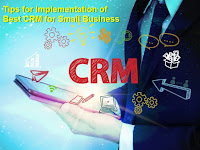
Tips for Implementation of Best CRM for Small Business


Implementation of a CRM demands an in-sync organization. Official guidelines should already be in place. Personal involvement is also often a necessity. The project manager needs to be capable. Internal communication is required to be up to the mark.The following tips should serve small businesses well while implementing an affordable or free CRM software in India.
 
The top management needs to fully back it

In order to make the activity of trotting the CRM path a resounding success, it is of crucial importance that the move has the full support and personal involvements of those in the top echelons of company management. The drivers of opinion in organizations, those who set work culture need to be the early adopters.

The Project Manager

It is obvious that the person in charge of implementing the best CRM for small business, the Project Manager, has a crucial role to play. All needed steps should be taken and it should be ensured that the goals are fulfilled. He or she does not necessarily have to belong in the management but must have the capability of completing the task at hand.

The role of the Super-user

Besides the project manager, another key personnel in this task is the super-user of the new CRM. It is necessary for this person to be enthusiastic as well as inquisitive about the new system. He is the internal support person an employee turns to. He is also often the contact point for vendors and usually has crucial information regarding the CRM system.

Make a big announcement

Like your product or service to your customers, your employees too need to be aware of the new CRM system. Make sure that everyone in the organization knows about it and can’t wait to use it. Build the hype. After the implementation, remember to keep tabs on how things are working out.

Guidelines for your company personnel

As the accuracy of the entered data is crucial to the proper functioning of a CRM take steps to ensure that relevant guidelines exist for company employees to refer to while inputting in the crucial information. Make sure all the relevant personnel is making proper use of the system.

Train you employees

There is going to be differences in how different people approach your new initiative. Some will be all for it and use the new system with motivated enthusiasm. Others will be skeptical and reluctant to adopt the new working style. The project manager needs to take cognizance of this fact and take necessary steps. Third party training is an option. Another is having the super-user train the individual concerned employee. New employees should at once be made acquainted with the way to navigate through the CRM.

·         Make a proper strategy

CRMs are much more than just another tech innovation. It is belief set that needs to be followed. Reconsider your existing routines and those of all employees. Address the fact that their work pattern needs to be modified. This is a difficult task as it will face hurdles on all levels. People are reluctant to change from their comfort zone and that is fact

Image Source : http://bit.ly/29pYS7c

Tuesday, September 27, 2016

5 Reasons Why You Need Retail ERP For Your Business

In the advanced time of business, the retail division has received huge success from consuming group of the general public. This article puts a light on the uses of erp software for retail and the difficulties confronted by the retail industry in the viable usage of the ERP programming. It introduces the aggressive advantages that the retail industry can reliably appreciate from utilizing ERP framework as a part of the retail business.
                                                                                                                 
                                                                                                          
This blog additionally puts a thin concentrate on top four driving ERP arrangement suppliers, for example, SAP, Oracle, PeopleSoft, BAAN, Microsoft Dynamics, and so forth and their aggressive competition and pitfalls. 

Retail is the offer of products to end clients, not for resale, but rather for use and utilization by the buyer. The retail exchange is toward the end of the store network. Producers offer extensive amounts of items to retailers, and retailers offer little amounts of those items to shoppers. A man who needs to get an item for his/her very own utilization will generally buy it at a retail location or from some other retail promoting channel. 

Hence, retailing provides to the offer of products or items in little amounts sold straightforwardly to extreme shoppers. Enterprise Resource Planning (ERP) is an incorporated computer based framework used to oversee inside and outside assets counting substantial resources, monetary assets, materials, and human assets. It is a product engineering whose reason for existing is to encourage the flow of data between all business firms inside the limits of the association and deal with the associations to outside business partners. Based on a brought together database what's more, typically using a typical figuring stage, ERP frameworks merge all business operations into a uniform and venture wide framework environment

Enterprise Resource Planning frameworks or the ERP frameworks allude to the product bundles that coordinate every one of the information and the related procedures of an association into brought together Information.

ERP software for retail uses a singular database that comprises every one of the information identifying with the different framework arrangements. So as to accomplish a consistent mix, an ERP framework utilizes various equipment and programming parts. ERP bundles are vigorously utilized by bigger retail chains. Intended to encourage the organization also, enhancement of inward business forms over an undertaking, ERP bundles have turned into the focused device for most expansive retail organizations.

ERP programming utilizes a focal database that ensures the distinctive offices to speak with each other through data sharing. ERP frameworks include capacity particular segments that are intended to collaborate with alternate modules for example, Accounts Payable, Accounts Receivable, the Order Entry, Buying, and Distribution and so on. 

Retail ERP frameworks include distinctive modules, for example, request passage, buy, deals, funds, stock administration, DRP (Distribution Resource Planning) and HR. The parts are intended to work easily with whatever is left of the framework and give a reliable client interface all through the framework.

Image Source : http://bit.ly/2d5wJlF

Wednesday, August 31, 2016

Have you opted for Cloud ERP India yet?

Cloud based ERP in India or cloud computing changes the customization condition. With cloud ERP India, organizations can grow show new productive growth in a matter of weeks rather than months or years, and extend all customization s consistently to the most recent arrival of the framework.  
                                                                                                                     
Changing ERP frameworks need not be a slow undertaking. Cloud ERP empowers fast customization through the distribution of strategies going from graphical customization to work process re-building and has the possibility to free organizations from the pressure of various supporting firms which are continuously blocking the new production. These cloud applications are customized starting from the earliest stage to be flexible and have a full grown system that ensures safe future-proofs customization's, the customization capability of ERP can be figure it out surely. 

With cloud computing, all procedures depend on a single code base and look over the update process. Putting ERP software in the cloud is a considerable measure quicker and less demanding than on-reason with the fact that the code base isn’t exclusive, it is norms based. This allows organizations to make their customization's into single platform and have these parts associate with different customization's through standards based web advancement systems, for e.g., JavaScript.

These cloud advancement systems naturally deal with combination of innovative skills –from the application layer to the database and working framework layers- so that designers don’t need to. Moreover customization of cloud ERP software is normal for standard items. Subsequently, at whatever point a cloud computing is moved up to a more current adaptation. This guarantees excessive assets are not spent physically moving customization's to the more current from and permits the association to exploit new advancements with new designs. 

It is likewise critical to perceive that you can’t accomplish the customization advantages of cloud based ERP by just facilitating on-reason applications. A facilitated framework is basically on-reason programming that has been outsourced to an ASP (Application Service Provider). Subsequently, facilitated software experience the negative effects of the same confinements as on-reason frameworks, including form lock, with the additional damage that the upkeep also, updates are planned just when the facilitating supplier or company makes them accessible. 

Facilitating on-reason frameworks makes modifying and overhauling considerably more troublesome, immoderate and unsafe.With cloud ERP India rapidly growing, it is imperative to choose just those cloud ERP sellers that have the development, broadness of usefulness and power of framework to advance growth.

To accomplish the required level of customization organizations need, value-based information and business process rationale must be interwoven utilizing institutionalized, stage free APIs. An adjustable cloud ERP stage must have a broadness of segments going from work process to scripting to web administrations.

Combinations, multi-national organizations and substantial partnerships have been backed off by legacy on-reason ERP frameworks that have been time and cost-restrictive to upgrade and modify to evolving business needs. Past customization s made to these legacy applications utilizing exclusive instruments had an illogical effect—they form bolted organizations, kept them from moving up to the most recent ERP discharge and restricting the capacity for these organizations to adjust their ERP frameworks to their necessities in a convenient manner.

Image Source : http://bit.ly/2bUSCCZ

Wednesday, August 3, 2016

5 Things You Should Know About Erp Software For Textile Industry.

ERP or Enterprise Resource Planning has been in Textile
industry for aerp software in textile industry significant long time. The need of ERP software for textile industry required more brilliant method for working and diminishing information repetition. The start of ERP began in 1960s when an open circle MRP (Material Requirement Planning) was presented. This MRP was connected to Bill of Material and Inventory Master File.

This MRP could discharge Purchase Orders, Work Orders and Rescheduling Notices in light of Planned Order. The real disadvantage in this framework was the control or check focuses. To leave these issues in 1970s appeared shut circle MRP. This model of MRP could check the limit prerequisites before producing any sort of Purchase or Work Order. Yet at the same time it use to work in disengagement of the Business Plan Financial and Marketing. This brought about MRP II in 1980s which on the requirement of Marketing and Financial Planning use to run the shut circle MRP. Still the business felt the need that every one of the assets of a venture should be incorporated which brought forth ERP and therefore all Enterprise wide assets were on single stage working for advancement with better arranging.

1990's initial ERP utilized customer server strategy where the customer frameworks use to have an application introduced that could get the data from the server. With the introduction of web ERP was pushed one more stride in 2000s where no establishment of customer application was required and the ERP moved to Web. With the introduction of Cloud processing and very perplexing cell phones, ERP turned out to be speedier and effectively available. 


The Textile industry is truly perplexing. Dislike car industry where the variations of a Single auto keep running on a solitary sequential construction system for quite a long time, clothing and material industry sees a great deal of variety consistently. With presentation of new creation frameworks which have been effective in Textile industry. All the aforementioned frameworks required spotlight on decreasing Work In Progress and Waste and Increasing activity on administrator preparing. To bolster fabricating framework numerous Solutions to Apparel and Textile Industry are being proposed; right from apparel handling, apparel following to ERP.

As the opposition is expanding and edges and timetables are being diminished, individuals in Apparel and Textile Industry have begun understanding that requirement for cost control and using the Enterprise wide assets to the most extreme have ended up crucial. 

ERP framework keeps up the advantages of a standard bundle with an abnormal state of flexibility, guaranteeing that the arrangement can be custom fitted to any prerequisite. Its modules could be arranged to the requirements of any material business, whatever its size. ERP comes as salvage to every one of these issues.


Contributor : Sushmita

Thursday, December 10, 2015

SOFTWARE VS. SYSTEM


A piece of a larger puzzle

SOFTWARE VS. SYSTEM - Expand ERP
The terms ‘accounting software’ and ‘ERP’ are often used interchangeably, but there is a vast difference among the two. The casual interchangeability in the usage of the two terms has caused confusion among some SMEs about what is the exact difference between the software and the system. The confusion between the two may have risen as companies that offered accounting software added more features and modules overtime and expanded into full ERP solution providers.

The accounting software that companies used previously dealt solely with financial transactions. The sales of goods, purchase of materials and order tracking were the main features of software solution. Accounting softwares include accounting information such as accounts payable, accounts receivable, trial balances etc. Other frequently bundled functions include billing, expenses, time sheets and sales and purchase orders.

Enterprise resource planning systems encompasses a much broader area and address more business functions. The ERP package covers functions beyond accounting and also factors in qualitative and intangible data. Production planning, ordering, customer relationship management, warehousing, inventory tracking, business intelligence business analytics are comprised within the ERP package. An organization with a fully implemented ERP has greater integration of data and information, better intra-organizational communication and streamlined processes. ERP systems allow a more in-depth view of each function of the organization. Thus ERP results greater transparency and control and by providing real time automatic reports it allows managers to make quick and correct business decisions.

Let’s take the ExpandERP system as an example which offers accounting solutions with financial management, budgeting, receipts and payments included. The package offers much more with customer relationship management, export, procurement and business intelligence modules as well. The entire system integrates and combines the data and with its business intelligence can help predict future profits and losses, lower cost of production by increasing purchase order efficiency, lower operational costs and over time boost the company’s growth.

An accounting software is a part of the ERP package. One can view the accounting solution as a part of the larger jigsaw puzzle that is ERP. While the system would be incomplete without the accounting part, it consists of far more parts that are combined together to form the big integrated ERP picture. Enterprise resource planning offers more than just financial book-keeping and delves into making the whole companies processes as streamlined and efficient as possible. Though the accounting and financial management module is one of the most integral part of the ERP package, its functionalities go far beyond.


Contributor : Vidushi