Showing posts with label cloud erp software. Show all posts

Sunday, April 15, 2018

5 Key Features Of An ERP Software For Exporters

Export businesses are highly competitive and multifaceted which makes it obvious to have an integrated application suite that the company can use to connect with its diverse active departments with real-time data sharing. Hence, ERP software for exporters is in immense demand throughout the world.

Companies incorporate ERP software into their business module for many good reasons such as- Accounting, stock control, HR activities, data sharing, business planning, market analysis and to name a few. By implementing ERP software in the process many businesses reduce production cost, save time and reduce manual efforts.


However, before a business decides to implement the software there are several other features that need to count, often depending on the specific requirements the company wants to improve. 

Compliant to export regulations:
ERP software is meant to manage, collect, store and interpret data from different activities including product planning, marketing, sales, inventory management and to name a few. The application for exporters create documents compliant to export regulations. It is a very smooth and streamlined application proposed to expedite paper works.

Accounting management:
The right ERP software for exporters is combined with accounting mechanism that helps the business track, record and consolidate all their operational information into a centralized system. It also manages data in a way that you can take deeper look into it to analyse future finance prospect. 

Customer Relationship Management:
Integrated and streamlined CRM helps to store and collect customer information in a central database. This means there’s a single point of data storage having all information of supplier, vendors and customer information that any authorized department can track and edit. While choosing right CRM for your exporting business, make sure it offers-

=> Timely reminders of your prospective activities on leads and sales
=> BI dashboard that analyse sales performance and count conversions
=> Targeted group to help you run email campaigns

The best part of ERP software is that it controls end-to-end business process with streamlining accurate information throughout the channels.

Enhanced mobility:
Mobility in everything is what calls the smart age. Mobility in ERP software means accessing application on the go through smartphones, not only in the workplace but from anywhere in the globe. Gone are the days of strolling around workstation to enter product information. ERP alone can take care of the inventory management along with other production procedures.

Procurement management system:
It is designed to allow a company to automate the purchasing process and maintain the inventory of goods. This software can generate purchase orders, market values, execute online order placements, online payment clearance and match invoice with the materials received. While deploying this system ensure it offers-

=> Define reminder levels and re-order levels for each product
=> Notify preferred supplier suggestions based on each product
=> Auto-generate purchase enquiry, purchase quote and order management

Procurement management system helps create streamlined administration throughout the departments.


Using ERP Software for exporters makes the entire business process more organized and improve the efficiency of operations. If you’re also from the same industry and looking for a smart business process, ERP software is the solution for you. 

Wednesday, April 4, 2018

Take a look on how ERP is transforming the Indian Business Scenarios

ERP software providers in India are witnessing rapid growth across the Indian market. A number of industries such as pharmaceuticals, steel, automotive, manufacturing firms, oil, textiles etc have already implemented ERP system for dominating production and development inefficiency. The growth has un-curtained the traditional business conduction, integrated ERP system not only optimizes the resources utilization but also delivers real-time data on demand.

Through surveys, it was captured that about 60% SME’s in India adopted ERP based solutions. This significant augment in the penetration level in this SME sector ascribed to the establishment of low cost ERP system that caters localization based on country and accessibility of technical talents and functions.


Did Indian market go with the ERP flow?

In the initial period, the Indian market was quite hesitant to integrate ERP into their company system in fear of building complexities, despite the fact that cloud ERP software has so much to offer. The companies’ intrigued with concept started implementing at back office; the way ERP came to use is undoubtedly fascinating. The companies were in dilemma with transforming their business activities because of crumpled illustration of the product and other possibilities the companies had to consider looking at the online market scope.

Time has changed and India is changing the IT scenarios globally. Besides, the significant IT players continue to endeavour market growth, ERP became the integral part for the companies to deliver commitments.

Present business scenarios with integrated ERP solution-

Companies remain thankful to the ERP developers as it helped them to streamline business activities. Today ERP is much more advanced where the focus lies in emergency market situations. However, the SME’s segment has transformed into the most optimistic connecting for ERP mechanism.

ERP’s multiple modules helped the SME’s to maintain budgetary requirements, this helped in smooth administration processes, be it stock, human resource, updated item cycle or merchandising shipments. Significant financial development of Indian market relies on companies to actualize and incorporate ERP. For organization waiting for a convinced cost-effective solution, it’s not too late to understand the benefit to cost proportion that an ERP can deliver to business needs.

Benefits of ERP to look at, when thinking of business expansion-

=> Responsive to market changes
=> Minimize cost
=> Enhance productivity
=> Increase efficiency
=> Better accessibility to document
=> Minimize inventory cost
=> Global outreach
=> Simplified planning
=> Enhance customer satisfaction
=> Apt usages of resources

In short, if you look for business automation ExpandERP is the solution, erp software providers in India deliver customized ERP software to cater specific business need. Over the years, cloud based ERP systems are about to witness a higher adaption. Simultaneously, the cloud-based commerce will be floated with scepticism in regards to data security and subscription cost for the small players. The way businesses are utilizing ERP it implies that the companies can now withstand the worldwide online commercial rivalry. 

Tuesday, April 3, 2018

Know how ERP and CRM are different yet so important for businesses

In India, usage of CRM and ERP solution is soaring high and for good reasons. CRM and ERP are usually separate but, so connected that CRM cannot work alone effectively without constant update from ERP- from placing orders, sales and logistics to deliveries.  While CRM manages company interactions, ERP Software Company in India offers an integrated administrative application system.


Let’s dig deeper to know where these two are similar and where not-

What is ERP? 
ERP is designed for business administration. It aims at consolidating business data that can be accessible for main operations across the enterprise. It’s a one-off integrated software package that facilitates business process management with real-time update to all concerned departments. For an instance, if a product is out of stock hence the shipment is cancelled, then the status would be sent through the channels to the concerned parties authorized to access the data. This allows departments to regenerate new plan for the issues before it actually makes things difficult within the organization.  ERP offers smooth method for streamlining business process.

What is CRM?
It is a storage database that keeps all the information of related to interaction with customers. CRM process includes categorization customer interactions, collecting and sharing data. CRM method is highly standardized which can be easily shared throughout the network. This smart system can be used by different office executives to create sales projections, representatives can use this to monitor contacts with clients and verify them by sending to shipping clerks. The main focus of CRM is to provide comprehensive customer data that can be used to create plan for client retention and sales improvement.

CRM or ERP: Which one do businesses need the most?
A business may need both the systems but it depends majorly on the integrities involved into the mode of operation. Nowadays, even a small business relies upon CRM system for better and accurate data collection. This is much more clutter-free and easy than collecting data from papers and numerous emails.

ERP is an important business essential that helps streamline business processes. Many large to even small scale industries are relying on ERP Software Company in India as well as abroad to gain better control of their businesses.  Having a single cloud platform integrated with CRM and ERP provides unified view that you can keep control over it from anywhere anytime.

The last note:
When you expect enhanced business growth there must be two things you need to obtain- one is more sales and second is fewer expense. Incorporating ERP and CRM let you enjoy both of them with ease. While CRM brings more clear data on customer interactions and more revenue insights, ERP system keeps the overall operation cost low.

Thursday, March 29, 2018

Smart way to manage inventory with multiple units

Inventory is one of the core business aspects traditionally handled by resources; significant details were manually documented and stored in filing cabinets. These traditional practices invited the glitches in transparent inventory management process; still, many companies are due to eliminate this archaic practice. If your company is one of them, it’s time to consult ERP software company in India. It is undoubtedly critical for every business regardless of types and sizes to effectively handle inventory levels and track items throughout the process.


If you want your business to grow, ERP is an absolute necessity. Handling multiple units has never been easy, especially when inventory management is involved. Installing a number of software to handle multiple units just raises the level of complexities. 

ExpandERP is one of the most trusted cloud ERP software, get real-time visibility across multiple inventory units virtually.

Magnify inventory management with ExpandERP:

=>  Stock transfer:
Keeping a track on stock transfers is definitely hectic, minor errors can be expensive deal to handle. ExpandERP enables you to handle multiple warehouse locations, stock points, sales depots through advanced channel concept. 

=>  Stores & bin: 
Dispatch and returns are crucial for managing inventory efficiently; it is significant for businesses to manage their inventory at store levels. With ExpandERP you can easily create inventory transfers between multiple stores in real-time, all you need to do is define bin locations and capacity where you want to transfer. The enhanced feature notifies the nearest bin location on pick and put away processes on manual conductions.

=>  Multi-unit conversions:
Creating stock transactions is something that needs multiple resources to keep a track of the process. ExpanERP enable you to prepare and control stock transactions for multiple units, the advanced features automate the stock conversion and adjustments at primary unit; further it helps you to define unit conversion facets at the product level. 

=>  Inventory optimization:
It is detrimental for a company to produce goods over or under demand when it has a global presence. The inventory must work on schedule in case of nature-wise perishable goods. ExpandERP enables you to plan your production accurately and replenish the requirements so that you can make purchasing decision across the units.

Why you need ExpandERP for managing inventory across multiple units:

1. Inter-location stock transfers
2. Real-time stock updates across multiple units
3. Inventory tracing from purchase to sales
4. Bin management cross the location, help to eliminate excess storage
5. Save time and increases resource productivity

Expand one of the renowned ERP software company in India offering the simplified inventory management and stock tracking solution for improvising efficiency and reducing transit costs. Our advanced inventory features enable the user to manage multiple units from a single console. Many businesses previously shied away from evaluating ERP software as the feasibility of layer of complexities. However, with Expand you get the best visibility on the entire inventory process incorporating suppliers, suppliers’ chain partner, accurate financial reports.

It’s not too late to automate your business processes, especially inventory because one solution is catering multiple disciplines.

Wednesday, March 1, 2017

The Key Compliance Features of Cloud ERP for Chemical Manufacturing

The delicate task of doing the balancing act between the pitfalls of adhering to these standards and retaining a competitive edge needs to be carried out with utmost care. A good cloud ERP for chemical manufacturing facilitates this process and helps companies to progress smoothly in this quest. Compliance costs are reduced and the business becomes more viable as well as profitable. Automation of the complex compliance procedure helps companies achieve this goal with finesse. This also allows managers to focus on matters that matter more like errors creeping into the data captured. Read on to know of the 6 features that your cloud chemical manufacturing should have.

The stringent compliance standards expected from chemical manufacturing companies are making it increasingly difficult for companies to retain their competitive edge. The host of legislations in place on a national as well as global scale present a conundrum to companies in this sector. Companies must already be well acquainted with legal bindings like SARA Title III, OSHA Hazard Communication Standard, the REACH legislation of the European Union.

You should be able to trace product ingredients as well as the final output with precision in both the backward and the forward lot. The ERP for chemical industry should be able to accommodate instructions for operation and technical sheets as defined by the end user. Control over the sub-lots and lots are also highly desirable.
Another wanted feature is audit trails where the process of obtaining, using, managing and securing the data is clearly demonstrated. Archives of data of previous years are also important, so keep that in mind.
Make sure that the internal workflow is secured by digital signatures. This ensures compliance with a number of audits. Make sure the digital signatures are linked permanently to objects and there is no way for them to be manipulated.

Processes linked to quality control need to be integrated into totality and the whole paperwork involved with the activity needs to be automated. Key terms to keep in mind as far as this feature is concerned are enforcement of inspection results at all of the vital points, orientation through rules etc. 

Make sure your system is flexible enough to accommodate both digital and scanned signatures, as and when required. For documents like analysis certificates and technical sheets, this is a matter of utmost necessity.
Make sure that your ERP provides advanced security features in order to prevent unauthorized access of and use of the system both externally in addition to internal sources of attack. Your system should log you off automatically after an amount of time has passed. All activity of users should be recorded in appropriate logs and the system should block the user after too many login attempts that fail.

These are just some of the features that should be kept in mind. There are many more that you will need in your daily activities. Be sure to check out the demo of Expand ERP which provides many advanced security and compliance features of ERP for chemical manufacturing.

Image Source : http://bit.ly/2mr8mEC

Thursday, December 22, 2016

Why ERP Software for Exports Should Have Integrated CRM Software Solution


If you think carefully enough you will come to realize that ERPs or Enterprise Resource Management solutions were always meant to be accompanied by CRM software. Having said that ,we must concede erp software for exports has proved to be invaluable allies of businesses on their own. But the magic works best when both are part of one software suite and their true potential unleashed.


These days, data is being generated in huge amounts as we speak and write. This has translated into an environment for businesses that far more complex for their owners than ever before. They have to meet the challenge of being able to take correct action and they have to do it fast. Otherwise, their business prospects take a turn for the worse both in terms of short and long term. Customers are faced with an exploding array of choices and are more demanding. Businesses have to respond to their demands or face obliteration. Competition takes the center-stage as hundreds of companies vie for the same money of individual consumers. But that is a natural consequence of the consumer is king model.

So, in order to prevent your business out of gears when that happens, it is far better to opt for a modern and flexible solution that not only has modules that may be customized and scaled easily but has a built-in CRM as well. That is truly the best software for export import business.

All this has resulted in more and more companies realizing that an ERP with a built-in CRM solution is the best option open to them. Today even small and medium-sized businesses are turning to such a breed of ERPs in order to better their business processes. The magic of automation and enhanced management is in full bloom when ERP and CRM are inherently integrated. 

ERPs perform the function of management and automation of back-office tasks while at the same time streamlining their business operations, CRM's look after the front-office machinery that is responsible for interactions with customers, management of the whole pipeline of sales, provide support, conduct up-sell activities, track information regarding customers and come up with dashboards and reports on the whole data collected through their system. CRM's are of great use in simplifying and standardizing all such activities.

But personally, obviously, for valid reasons, the concept of mashing up two different products from two distinct vendors does not seem to me to be that great of an idea. The different products make use of different architectures and the absence of any pre-set standard when it comes to exchange and interaction of data makes them unwieldy and unreliable. Not only does such a solution prove to be prohibitively costly but makes the whole process unnecessarily complex. 

It is a risky decision and I as a business owner am highly unlikely to make such an unwise move. Sometimes companies claim that their solutions have integration compatibility but future updates may break such integration's and make the whole system inoperable.

Thursday, November 24, 2016

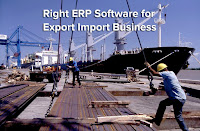
Picking the Right ERP Software for Export-Import Business


When it comes to taking a pick for the software for export import business which is right for your business you may feel a bit overwhelmed. But when your ERP software for exports needs to have a specific functionality the task can quickly become a headache. Accounting, Inventory, Basic CRM functions are handled by almost all ERPs. But at the same time if still stick to manual procedures in other processes it wont help your business much. You need to consider not only the ERPs that provide a comprehensive functionality but also which ones can be tailored to suit your needs.

The Factors that need to be considered

If you consider the functions, there are a number of components which are important in an import- export management tool. Tasks like tracking costs, the ability to account for various currencies and customs processing done the automated way fall under their preview. Besides, the functionality you should also consider support, costs and the satisfaction of previous clients with the software tool.

In order to have your inventory costs accurate the software has to take into account landing costs. Such costs are inclusive of taxes, brokerage, freight and duty. Once you have detailed reports about the products cost you can then set an appropriate selling cost for individual products.

If you are operating on a global scale then you just have to deal with multiple currencies. This makes it easier to change your selling price according to cost fluctuations. The scope of human error in calculation is also removed. You just must have software for export import business that keeps a track of what your customers owe you and in which currency and what do you owe them.

Automation of customs procedures saves loads of time which would otherwise have been spent in the manual organization, entry and updating all the relevant information.

Customer satisfaction too should figure prominently in your ERP checklist. Dont be afraid to ask people using the ERP in order to know its advantages and drawbacks. Let the ERP vendor get acquainted with your business and make a customized pitch. A vendor who understands the needs of your business, as well as the particular industry you operate in, will be in a better position to be of help to you.

Lastly, keep in mind the support factor. If you may need round the clock support does the ERP vendor offer that? Remember that large software companies outsource their support services while a startup will be able to provide a more customized support experience in-house.


To Sign Off

Before you hand over the check for your ERP make sure that the system is best suited for your business processes and industry relevant practices. Some vendors customize their products while others offer specialized modules out of the box. The latter is usually less expensive and chances are that the vendor too is experienced with the needs of your industry.