Saturday, November 12, 2016

The Key Takeaways from Manufacturing ERP Software


As far as technological tools are concerned manufacturing ERP software is one of the foremost priorities for businesses engaged in this sector. This is due to a host of reasons but primarily because the manufacturing landscape is full to the brim with competition. This forces business concerns to build, design and deliver the products that are only of the highest quality that too keeping strict time frames in mind without having your manufacturing costs blown out, so that you may acquire new customers and retain existing ones.


But the challenge that lies in front of manufacturing firms too is considerable. You have stay on top of the game in the various processes of production, distribution, and sales.With the right ERP for manufacturing industry firms can take advantage of the advanced functions and features it offers and improve the facets of their diverse operations be it engineering, procurement and sourcing, production, testing the quality of products up to final delivery.

Modern manufacturing ERP software lets companies do the following:
  • Better their visibility
With an ERP in place, all the respective departments have all of the information necessary for the optimal execution of their tasks in real time at the click of a mouse. And this data remains consistent throughout the various processes of the business. Coordination between the various teams and departments within an organization is thus made as smooth as possible and all procedures along with processes may be executed in a far better way.
  • Boost their efficiency
 ERPs meant for manufacturing sector lets firms track the entire activities going on in the supply chain that too in minute detail right from the word go till where the procedure ends a task not thought possible earlier. Bottlenecks and problems may thus be identified with ease and corrective action taken in order to ensure efficiency.
  • Deliver within stipulated time frames
 All of the benefits of a good modern ERP contribute towards improving delivery times keeping in mind the stipulated time frames for the same delivery. This is a crucial metric used to gauge performance in the manufacturing industry as it is today.
  • Better quality of products
 By putting into use an ERP meant for the manufacturing industry, it becomes easier for firms to monitor defects and problems in products and pinpoint with accuracy the place where the design or production flaw is exactly occurring. Then they are free to take corrective measures and ensure product quality. This will lead to an increase in the sales of the firm, ensure satisfied customers and peg up profits.
  • Reduction of costs
ERPs reduce costs in manufacturing as well as other industries. The productivity of workers in boosted. Precision in production results in a reduction of scrap and re-work that can quickly exhaust the available financial resources of an organization. Components of goods and finished products turnovers can be tracked in more detail. Demand planning is made more accurate and excess inventory is minimized. Improved visibility results in pinpointing the areas where more savings may be made. All of this reduces the cost of goods to the company.
  • Better collaboration
ERPs enable a company to share their data with not only employees but with suppliers, vendors and distributors as needed and to the extent needed. Communication between the varied parties involved is enhanced and coordination reaches an optimum level.

Friday, October 28, 2016

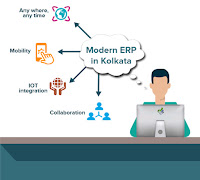
What You Can’t but Should Expect from A Modern ERP in Kolkata


Admittedly Kolkata for all its charm and nostalgia is not the financial hub of India. But that does not deter thousands of small businesses from starting a shop and thriving in this complex atmosphere of layers of contradictions. If you are located in the eastern region of India, then before you go shopping for an ERP in Kolkata, check out whether it has the following features which form the backbone of any modern ERP that can truly stand up to the best of the world.


Even businesses with existing ERPs in place would do their operational efficiency a world of good by investing a modern variant of this highly popular system which is peerless in its enviable combination of efficiency and popularity. A modern ERP should have the following features:

An Integrated CRM- What can possibly matter more to a business than its valued customers. A good CRM ensures that one-off purchasers are converted into returning and loyal customers. Customers relationships matter and ideally you would like to have your pulse on the exact customer demographics. Integrated calendars and reminders make CRM a breeze for owners of businesses or the respective departments in large departments.

Export Management- Many businesses in the region concentrate on exports thus making it imperative that the ERP contains invoice and packing lists features. Forward contracts and export incentive are other areas of concern for them.

Inventory Management- An ERP that helps in inventory management through software is nothing short of a boon. Major features to watch out for are the transfer and routing of stocks, management of contacts along with management of the Bin and Stores.

Accounting- Accounting is an essential part of any business process. Your ERP should pass with flying colors when tested on this front. Pay particular attention to credit notes and cost centers in addition to overall management of the finance of your business concern.

Production- In the case of industries if nothing is produced, nothing is consumed leaving you with a bad business at hand. The ideal ERP should have provisions for quality checks, advice on the production process and production of the bill of materials.

HR or Payroll- Increasingly it is being found that the payroll function of the entire business process is being centralized and your ERP should have no problems in making this long felt need, another problem solved. This comprehensive process should comprise of payslips, management of payroll and management of employees.


·       Self Services- In this era of online stores customers more than ever eager to check their other issues that concern them themselves. An ERP should facilitate this process with a state of the art customer portal, a well designed and thought out shopping cart along with the final barrier to a sale, payment gateways that integrate with process of shopping without a hitch
        
If you are wondering whether you can really expect all of this plus more from an erp in kolkata then stop wearing out your grey cells and pay a visit to ExpandERP. It is kolkata's own but packs a punch thay maybe compared to the best professional boxers that you are likely to find anywhere.

Wednesday, October 19, 2016

Why most businesses require ERP solution providers in India to run smoothly


The various exporters and OEM to global companies have also outlined and set criteria for partner companies to be ISO certified, ERP enabled and various other organizational streamlining. The leading ERP solution providers in India are coming up with innovative solutions for the business. Apart from the few big players in ERP space, NetSuite, QuickBooks, Expand ERP, Zoho and many more online providers are making solutions more affordable and friendly for the users in India. The solutions are more integrated and more robust to manage the operations end to end. The software are now integrating services of CRM, ERP and ecommerce on single platform so that businesses do not have to worry about data transfer and repeated data entry.

India is today a major consumer market and emerging significantly in the global economy. The boost has been from various sectors and industrial development. According to a survey out of about 30 emerging markets India ranks the top. Development in various sectors like healthcare, infrastructure and financial sectors has fueled the growth. Foreign direct investment is all time high. The investments in start-ups have been the highest in this year 2016. 

The present government initiatives on ease of doing business and make in India has attracted foreign companies setup their facilities. The Information technology scenario in India has been favorable and impacted positively. Small and medium businesses are striving to get organized and automated with the help of ERP Service Providers in India. With the help of enterprise software and integration businesses are trying to become more efficient and survive the competition from global players. 

ERP on cloud has helped make the Indian business more secured with data backup and other disaster recovery features. Besides other big players in Cloud services, Microsoft also has come up with their data centers in India and offering Azure services. Expand ERP is one such erp solution provider in india offering the service on Azure cloud bringing absolute reliability and scalability to Indian small and medium business. The global companies are betting high on the start-ups and also on such innovative ERP software companies who are adding value to businesses and making them more efficient and productive. 

As the economy has become liberalized and transactions across borders are increasing in the digital space, the companies have to gear up for higher and higher volumes. Such volumes cannot be handled by basic software and any serious business will have to adopt some enterprise solution to integrate the processes and control costs. The ERP market in India is expected to exponentially grow at a CAGR of 25.4% until 2020. The major contributor in the growth of ERP is Cloud. Enterprises of all sizes are driven towards cloud based ERP. 

The adoption of Cloud ERP in the small and medium sector has outperformed the large companies. However with the growing awareness of Cloud the companies also need to know the best practices in cyber security like not to share login details and not to leave systems open when away from desk. Various banks in India are doing an excellent work in making end users aware of such best practices from Net banking and other online business transactions. In a nutshell the future is driven by cloud and SME is the frontrunner in India.